

What is GEO?
GEO (Generative Engine Optimization) is the process of optimizing your content not just for traditional search engines but for AI-driven answer engines powered by Large Language Models (LLMs). Instead of focusing solely on rankings, GEO ensures that your brand and content are chosen as trusted sources when generative AI provides answers to users.
In short:
-
SEO = Optimize for Google/Bing search results.
-
GEO = Optimize for AI-powered direct answers.
GEO vs. SEO
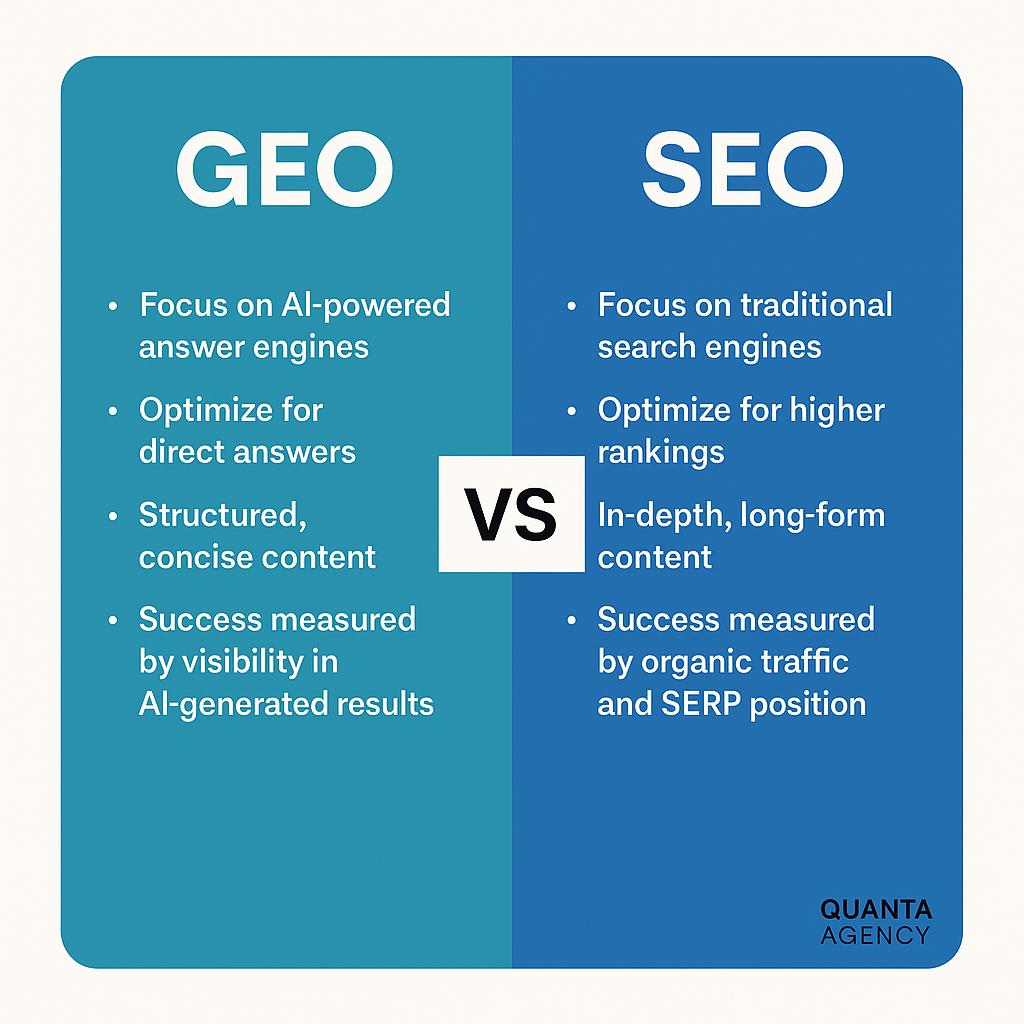
Although both strategies overlap, they serve different purposes:
-
SEO (Search Engine Optimization):
-
Focus on keywords, backlinks, technical performance, and user experience.
-
Goal: higher ranking in SERPs.
-
Success measured by click-through rates (CTR) and organic traffic volume.
-
-
GEO (Generative Engine Optimization):
-
Focus on structured, trustworthy, and concise content.
-
Goal: being cited by answer engines like ChatGPT.
-
Success measured by brand visibility in AI-generated answers.
-
For years, SEO (Search Engine Optimization) has been the dominant strategy for digital marketing, helping websites gain visibility on SERPs (Search Engine Results Pages) and attract organic traffic. However, with the rapid rise of Generative AI and answer engines such as Google SGE, ChatGPT, and Perplexity AI, a new optimization model has emerged: GEO (Generative Engine Optimization). While both SEO and GEO aim to increase visibility, their methods, goals, and outcomes differ significantly.
1. User Interaction
The biggest difference lies in how users interact with the content. In SEO, users enter keywords into a search engine, scan the SERPs, and decide which link to click. GEO, on the other hand, operates in an answer-first environment where users receive a direct response from an AI-powered system. Instead of browsing multiple pages, they often get everything they need within a single conversational reply.
2. Content Format
SEO traditionally relies on long-form content, optimized landing pages, and keyword-rich articles. Ranking depends heavily on backlinks, technical SEO, and keyword placement. GEO content, however, needs to be structured, concise, and contextually rich. Answer engines prioritize content that can be broken down into short, digestible snippets, FAQs, and structured data, which they can easily pull into AI-generated responses.
3. Metrics of Success
SEO measures success by rankings, impressions, and click-through rates. The higher you rank, the more organic traffic you receive. In contrast, GEO focuses on whether your brand or website is cited by AI engines as an authoritative source. Visibility is no longer just about SERP position but about being referenced in AI-powered answers.
4. Traffic Impact
SEO drives clicks, but GEO is reshaping how users reach websites. With the rise of zero-click searches, organic traffic is declining because AI systems deliver direct answers without requiring a visit to the source site. Businesses that adopt GEO early can maintain brand presence even as traditional traffic drops.
5. Strategic Mindset
SEO is about competing for rankings; GEO is about building authority and trust so that AI considers your content credible enough to include in responses. This shift makes E-E-A-T (Expertise, Experience, Authority, Trustworthiness) even more critical.
Integrating GEO with SEO
SEO is not dead—it’s evolving. The best strategy is to combine GEO with SEO:
-
Publish pillar content for SEO while creating concise answer snippets for GEO.
-
Use structured data (Schema Markup, FAQPage, HowTo) to help AI engines parse content.
-
Enhance E-E-A-T (Expertise, Experience, Authority, Trustworthiness) for credibility.
-
Leverage semantic SEO with LSI keywords (e.g., conversational AI, zero-click search, AI-driven answers).
“GEO vs SEO is not either‑or. SEO drives visibility in search engines, while GEO ensures your content appears in AI‑generated answers… E‑E‑A‑T is critical for both. Strong signals of experience, expertise, authority, and trust help improve rankings and AI citations alike.”
GEO Impact on Organic Search
Generative AI is transforming organic search visibility:
-
Fewer clicks to websites: Answer engines often give complete responses without requiring the user to click (zero-click searches).
-
Higher trust for cited brands: Companies referenced in AI answers gain authority and credibility.
-
Smaller but higher-quality traffic: While total clicks may decrease, the leads you get from GEO are more engaged and conversion-ready.
Transformation in User Search Behavior
User search habits are undergoing a revolution:
-
People prefer conversational queries (“What’s the best SEO strategy for startups?”) instead of short keywords.
-
Users want immediate answers, not endless browsing.
-
Answer-first experiences mean trust and authority matter more than ranking positions.
This shift forces brands to optimize not just for search rankings but also for AI-powered user experiences.
Benefits of GEO
The advantages of adopting a GEO strategy include:
-
Increased brand visibility in AI-generated answers.
-
Reduced reliance on SERP rankings.
-
Higher trust and authority when cited as a reliable source.
-
Better conversions because AI surfaces your content to qualified users.
-
Future-proof marketing aligned with the evolution of search engines.
Challenges and Limitations of GEO
While Generative Engine Optimization (GEO) is shaping the future of digital marketing, it is still in its early stages and comes with several challenges and limitations. Businesses must understand these obstacles to create realistic strategies for visibility in AI-driven search ecosystems.
1. Lack of Clear Guidelines
Unlike SEO, which has decades of established best practices, GEO is relatively new. Answer engines like Google SGE, ChatGPT, and Perplexity AI do not provide transparent ranking factors or optimization rules. This lack of clarity makes it difficult for brands to design consistent GEO strategies.
2. Dependency on AI Models
Generative AI systems are trained on vast datasets and may not always cite original sources. Even if your content is high quality, there is no guarantee it will be selected in AI-generated answers. This creates uncertainty for businesses relying on organic visibility.
3. Zero-Click Reality
One of the biggest limitations of GEO is the zero-click search problem. Since answer engines often deliver full responses within the interface, users may not need to visit the original website. This reduces traffic, even if your brand is cited.
4. Constantly Changing Algorithms
Just like traditional SEO, GEO is vulnerable to frequent algorithmic updates. As AI models evolve, strategies that work today may quickly become outdated. Businesses must remain agile and continuously adapt.
5. Measuring Success is Difficult
In SEO, success is measured by rankings, impressions, and CTR. GEO lacks standardized metrics—visibility in AI answers is harder to track, making ROI calculations complex.
How Generative AI/Answer Engines Work
The rise of Generative AI has introduced a new era in digital search. Unlike traditional search engines that simply display a list of links, answer engines such as ChatGPT, Google’s Search Generative Experience (SGE), and Perplexity AI provide direct, conversational answers to user queries. This shift has transformed how information is discovered and consumed, and it requires businesses to rethink their optimization strategies through GEO (Generative Engine Optimization).
1. Crawling and Indexing Web Content
Just like Google’s traditional search algorithms, AI-powered systems rely on crawling and indexing to gather data from the web. However, answer engines don’t just store links—they collect contextual meaning, metadata, and structured content. This allows them to extract specific insights rather than just matching keywords.
2. Training on Large Language Models (LLMs)
At the core of generative AI are Large Language Models (LLMs), which are trained on vast datasets of text from websites, books, articles, and other digital sources. These models learn to understand natural language, detect patterns, and interpret user intent. Unlike traditional search algorithms that primarily rely on keyword matching, LLMs enable engines like ChatGPT and Google SGE to grasp semantic meaning and deliver contextually accurate results.
3. Synthesizing Responses from Multiple Sources
When a user asks a question, answer engines don’t pull from just one source. Instead, they synthesize responses by combining insights from multiple authoritative references. The result is a coherent, informative, and concise answer. This is why having structured, trustworthy, and semantically rich content is critical—AI is more likely to include your content in its knowledge synthesis if it meets these criteria.
4. Delivering Conversational Answers
One of the defining features of generative AI is its ability to provide human-like, conversational responses. Instead of static snippets, users receive dynamic answers that adapt to follow-up questions, mimicking real dialogue. This makes the user experience faster, more intuitive, and more engaging compared to traditional search.
Why GEO Matters
If your content is structured, reliable, and optimized for GEO, AI answer engines are far more likely to cite your brand as part of their generated response. In a world where zero-click searches are growing, being referenced directly inside an answer is the new benchmark of digital visibility.
7 Strategies for Effective Generative Engine Optimization
-
Write for People, Not Just Machines
-
Clear, concise, conversational content.
-
Prioritize user intent.
-
-
Use Structured Content Formats
-
FAQs, bullet points, numbered lists, and summaries.
-
Makes it easier for AI to extract answers.
-
-
Leverage Schema Markup
-
Implement FAQPage, HowTo, and Organization schema.
-
Signals credibility to AI crawlers.
-
-
Prioritize E-E-A-T
-
Show expertise through author bios, references, and citations.
-
Build trust by linking to authoritative sources.
-
-
Update Content Frequently
-
Generative AI prefers fresh, up-to-date information.
-
-
Target Conversational & Long-Tail Queries
-
Optimize for natural language search.
-
Example: “How does GEO affect organic search in 2025?”
-
-
Build Topical Authority
-
Cover related subtopics in depth.
-
The more semantically rich your content, the more likely AI engines cite you.
-
Future Potential of GEO
The future of Generative Engine Optimization (GEO) looks exceptionally promising as the digital landscape shifts from traditional search engines to AI-powered answer engines. While SEO (Search Engine Optimization) will continue to play a role, GEO is poised to become the core strategy for maintaining visibility in an environment where generative AI dominates.
1. AI-Driven Search Will Become the Norm
By 2030, it’s expected that the majority of online searches will be handled by AI systems rather than traditional SERPs (Search Engine Results Pages). Instead of browsing links, users will rely on instant, conversational answers provided by engines like ChatGPT, Google SGE, and Perplexity AI. This transition makes GEO critical for businesses that want to stay visible.
2. GEO as a Core Marketing Strategy
Today, many businesses still view GEO as optional. But as answer engines replace keyword-based search, GEO will evolve into a must-have digital marketing strategy. Companies that optimize their content for semantic understanding, structured data, and trust signals (E-E-A-T) will gain long-term advantages over competitors who cling to SEO alone.
3. Personalized AI Search Experiences
As answer engines advance, they will deliver personalized search experiences tailored to each user’s behavior, preferences, and context. GEO will help brands ensure their content is not only visible but also relevant and personalized, improving engagement and conversions.
4. Winners vs. Losers in the AI Era
Ultimately, GEO will determine the winners and losers of the next decade in digital marketing. Brands that adapt early will secure their authority and presence in AI-driven search ecosystems, while those that resist may see their organic traffic vanish.
Is Your Organic Traffic Disappearing?
The honest answer: Yes, if you rely only on traditional SEO.
-
Zero-click searches are increasing.
-
Generative AI is redirecting traffic from search engines to direct answers.
-
Businesses ignoring GEO risk losing visibility.
But there’s good news:
If you integrate SEO + GEO, your brand won’t just survive—you’ll thrive in this new AI-driven search ecosystem.
Case Studies: Brands Leveraging GEO Successfully
As Generative Engine Optimization (GEO) gains momentum, some forward-thinking brands have already started experimenting with strategies to adapt to AI-driven search. Their early adoption demonstrates how GEO can shape brand visibility in the age of answer engines like Google SGE, ChatGPT, and Perplexity AI.
1. The New York Times – Structured Journalism for AI
The New York Times has been proactive in structuring its articles with clear headings, FAQs, and schema markup. This not only boosts their SEO performance but also makes their journalism highly digestible for LLMs (Large Language Models). As a result, NYT content is frequently cited in AI-powered responses, reinforcing its authority in digital news.
2. HubSpot – Building Topical Authority
HubSpot, a leader in inbound marketing, has invested heavily in pillar pages and topic clusters. Their structured, educational content enables AI engines to easily synthesize answers from their resources. HubSpot has successfully positioned itself as a go-to authority in marketing automation, ensuring brand mentions in conversational AI queries.
3. Mayo Clinic – Healthcare Expertise
In the healthcare sector, Mayo Clinic provides concise, evidence-based answers to common medical questions. Their use of trust signals, references, and structured medical guides aligns perfectly with E-E-A-T principles (Expertise, Experience, Authority, Trustworthiness). Because of this, Mayo Clinic frequently appears in zero-click answers and AI-driven health queries.